
A Career in Peer Support
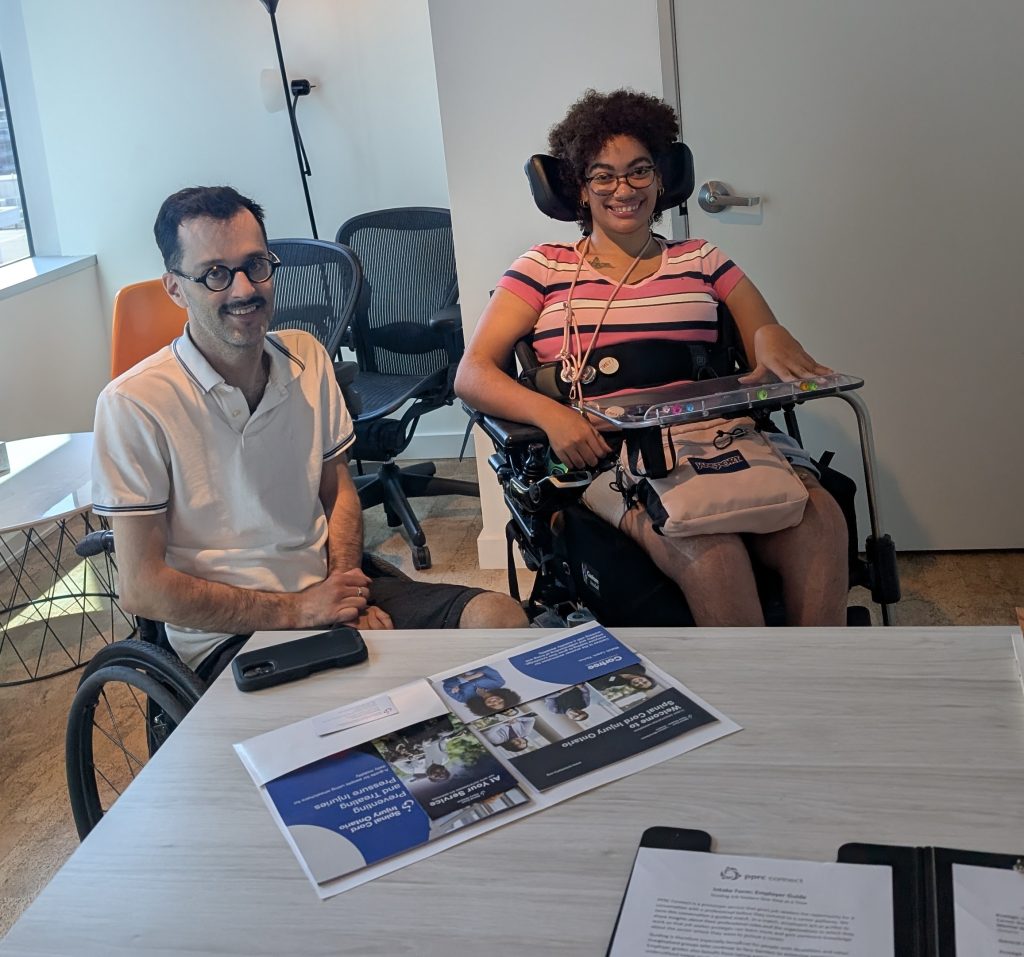
When you work for a not-for-profit organization in a peer support role you wear many hats. That’s just one of the key insights that mentor Brett Babcock brought to his conversation with PPRC Connect job seeker Jay Baldwin when the two of them met for a mentor match. He noted too that a lot of what he does is “listening and lending an ear.” Brett and Jay’s conversation held many such valuable learning moments. Brett is the Peer Support Coordinator for Spinal Cord Injury Ontario.
PPRC helps overcome barriers to employment for people with disabilities. One of the tools we use to help our clients overcome these hurdles is PPRC Connect, a mentoring service. By connecting with an employer mentor, like Brett Babcock, job seekers are guided to learn about a career from a professional working in their field. Job seekers use the knowledge gained from these opportunities to solidify a career goal before embarking on their employment journeys.
Mentor Brett emphasized to Jay that having lived experience of disability, is a definite asset. As Brett opined: “Put value on what your disability brings to the table … There is so much valuable information that I’ve acquired just by living with a disability.” He further pointed out that many people with disabilities must demonstrate creativity and problem-solving skills every day to navigate their lives. These skills are the same ones that can enable them to succeed in the workplace too. Jay welcomed this sentiment because it reinforced what they had learned in their own life.
Brett works primarily with people who have experienced a spinal cord injury and those with related conditions. As a peer support coordinator his responsibilities encompass activities such as assessing clients’ needs, providing access to community resources, and facilitating support groups.
Brett has also met with people – newly traumatized by a spinal cord injury – who want to consider medical assistance in dying. These are difficult conversations that he has approached with sensitivity, to have honest dialogue about how people feel and then to explore what their options to return to the community could be. It has been very rewarding for him to see these clients change their perspectives as they realize a new life is possible with the right supports and community resources in place.
What Brett is most proud of creating is a support group for those who belong to the LGBTQ+ community, the first of its kind, and a community that he belongs to himself. This was another point of resonance for Jay who remarked, “I created my own Facebook page called ‘Disabled, Queer and Fabulous.” Brett is proud that all the peer support roles in his organization are filled with people with lived experience of a spinal cord injury or a related physical disability.
Brett observed that, “Peer support is essentially knowledge exchange.” Jay concurred with his appraisal and noted that organizations like Spinal Cord Injury Ontario “are so important because people will see what you do as a model for what they can do for their workplaces.” Jay then concluded their conversation by saying “Thank you for spending time with me and for enlightening me on the work that you do.”
PPRC Connect can help you find a care, make the connection.