

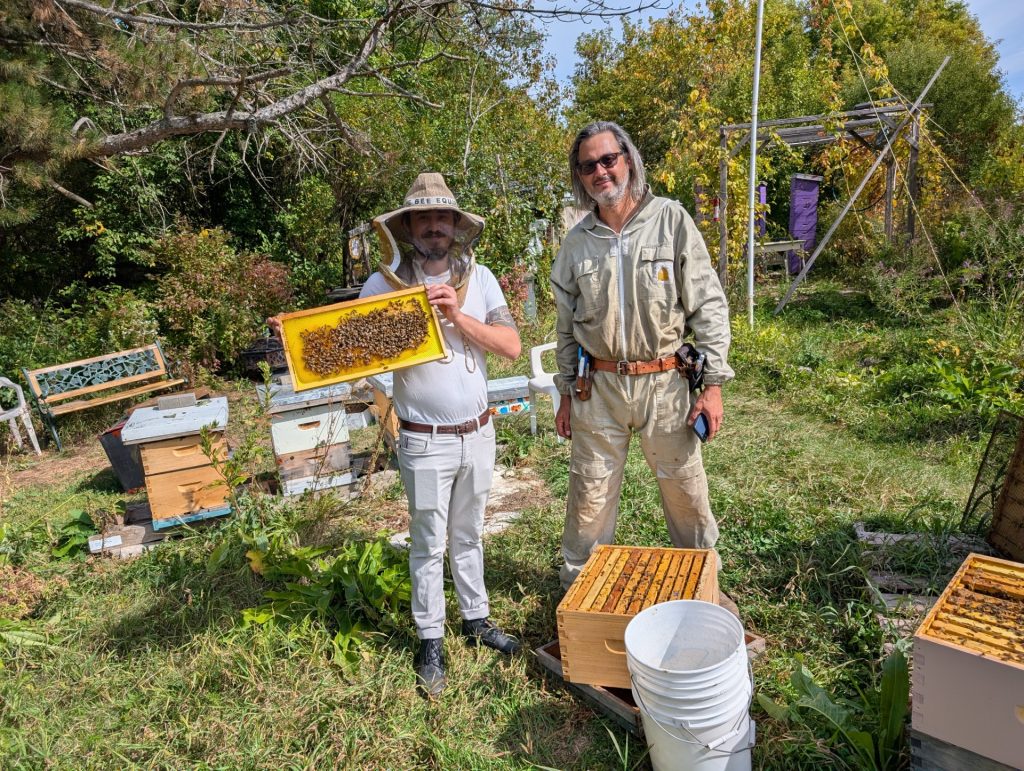
Over 400 species of bees live in Ontario but only some are honeybees. That is one of the many things that PPRC Connect client Simon Choisnet learned when he spoke with Capital Bees owner Ron St. Louis about exploring a career in beekeeping.
Simon’s curiosity about a career in beekeeping led him to participate in PPRC Connect, the mentoring service offered by Performance Plus Rehabilitative Care Inc. (PPRC). This service connects job seekers with disabilities with mentor guides who can help them solidify a career goal and learn what working in a particular employment sector is like.
Simon learned that beekeeping is seasonal. As mentor Ron put it: “The answer to any question about beekeeping always starts with ‘It depends.’ It really depends on the season.” In keeping with that sentiment, Ron explained that much of the intensive work of a beekeeper begins in spring. That is when bees begin to feed and mate. In summer, the Queen begins laying eggs, over a thousand a day. Autumn is the season when harvesting honey and making honey related products happens. In winter, the bees are inactive but then beekeepers do their paperwork, and plan for the upcoming spring season, and the cycle begins again.
If beekeeping is seasonal, Simon wanted to know if this is a career that he could pursue. To this question, Ron responded that beekeeping can be a hobby, a part-time activity, or a job as you gain experience and with expertise and knowledge it can also become a full-time career. Some people are self-employed, like Ron. Others find jobs with large companies that send small teams to care for beekeeping operations which are set up by businesses around Ottawa in locations such as rooftop gardens.
Simon also wanted to know what skills are required to be a beekeeper. Ron said key skills are assessing situations, making hive decisions, and being an adaptable problem-solver. A beekeeper needs to be physically fit, have good eyesight and the ability to lift heavy items.
To increase your skills as a beekeeper, Ron recommended finding a mentor to shadow, looking for hands-on-learning experiences, and taking courses on the care of bees. Ron also offered that joining local and provincial beekeeping associations is an excellent strategy to build a potential career.
Continuous learning is essential to become proficient and to stay well informed. In Ron’s words, “Bees are complex. You never stop learning. I’ve been doing this for almost 15 years now and there are still some days when I feel I don’t know anything about bees. That’s what makes it so beautiful, bees are an infinite source of curiosity and learning.”
Simon observed: “l learned it was a lot more involved that I thought it would be and I liked learning that it’s possible and it’s doable. Ron gave me some tips to get started on the ground floor so I’m more confident now than I was a week ago about this kind of job.”
Networking through PPRC Connect can help you identify your career path and be instrumental in setting your goals for employment.